


How to Spot Wind Damage on Your Roof Before It Becomes a Bigger Problem
After a strong thunderstorm rolls through North Alabama, most homeowners look out at their yard, check for downed tree limbs, and move on with their day. What many don't think to chec, but absolutely should, is the roof. Wind damage is one of the most common and most misunderstood forms of storm damage that homeowners face. It often doesn't announce itself with an obvious leak or a collapsed section; instead, it hides in subtle ways that slowly allow water to penetrate your home, leading to rot, mold, and structural deterioration that costs far more to fix than the original damage would have.
For homeowners across Huntsville, AL and the surrounding communities, understanding how to spot wind damage on a roof is one of the most valuable things you can learn. Whether you're dealing with the aftermath of a severe thunderstorm or simply trying to assess your roof's condition before storm season, this guide will walk you through the key signs to look for and explain when it's time to call in a professional for roof repair or roof replacement in Huntsville, AL.
1. Missing or Displaced Shingles
The most obvious sign of wind damage is shingles that are partially or completely missing from your roof. Wind acts on shingles like a hand peeling back the corner of a piece of tape once a shingle's adhesive seal is broken, the wind gets underneath and lifts the entire piece, sometimes tearing it free entirely. Shingles that are missing leave the underlayment and roof deck completely exposed to the elements, creating an immediate pathway for water intrusion.
Displaced shingles are equally concerning. These are shingles that haven't blown off entirely but have been lifted, shifted, or cracked by wind force. From the ground, they may look like they're still in place, but the sealant bond on their lower edge has been broken. Rain water can now flow underneath the shingle rather than being directed down and off the roof as designed. Over time, this leads to wet underlayment, damaged roof decking, and eventually ceiling stains or active leaks inside your home.
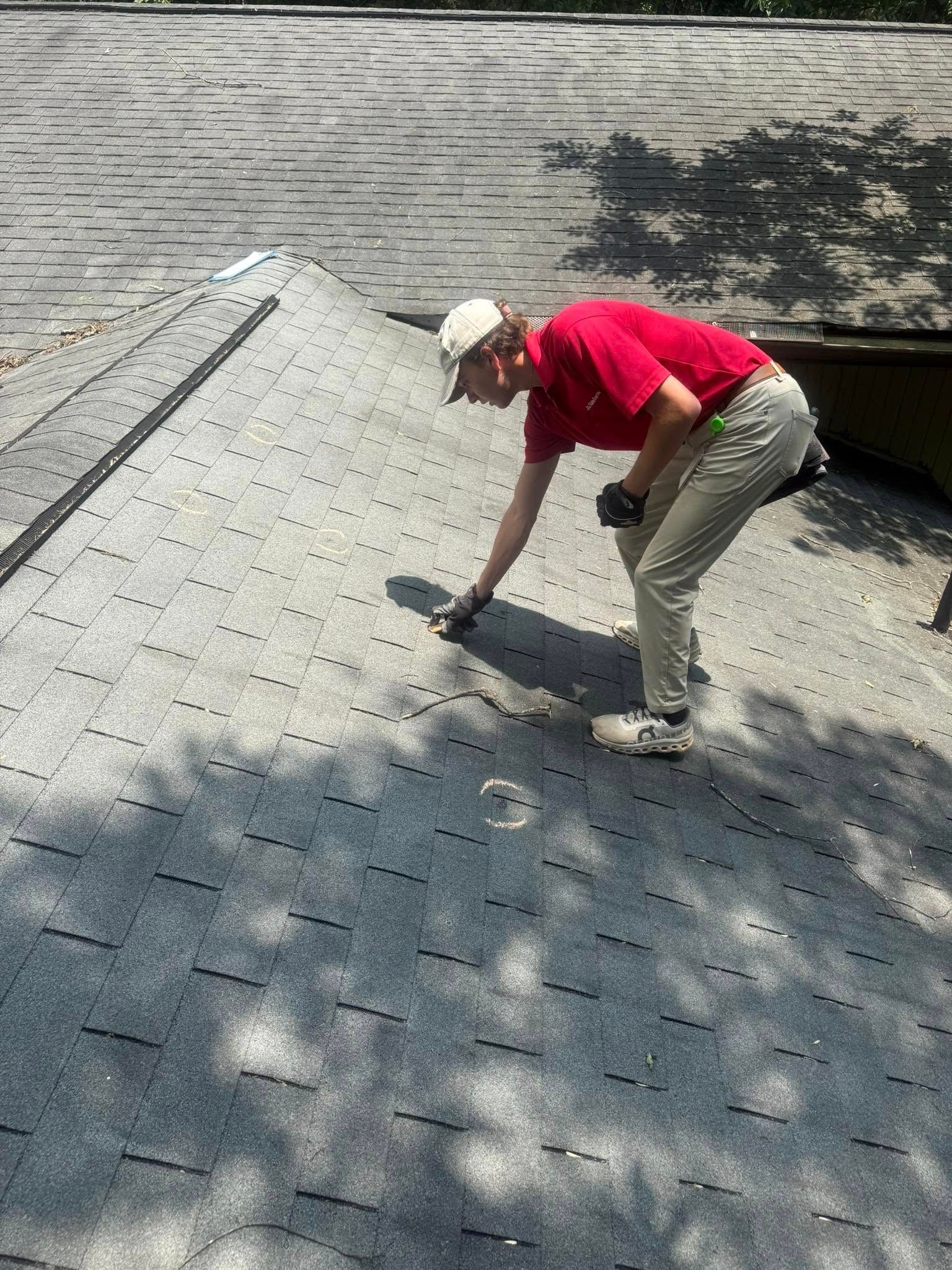
To check for missing shingles, start by walking around the perimeter of your home after any significant windstorm. Look for shingle fragments on the ground, in gutters, or against fences and landscaping. Then look up at your roofline, gaps in the pattern of shingles or areas where the dark underlayment is visible are clear signs of missing material. Binoculars can be helpful for getting a closer look without getting on the roof yourself.
It's worth noting that shingles can fail in patterns. If your roof lost shingles in one area after a storm, the same area may have sustained additional damage, weakened adhesive bonds, fractured shingle tabs, or loose nails that make neighboring shingles vulnerable to the next storm. Getting a professional inspection after any episode of shingle loss is the only way to know the true extent of the damage.
2. Lifted or Curling Shingle Edges
Wind damage doesn't always result in shingles leaving the roof entirely. Often, the more insidious problem is shingles that have been lifted at their edges but have settled back down, making the damage nearly invisible from the ground. This phenomenon sometimes called "wind creep" occurs when strong gusts repeatedly lift and resettle shingles, gradually breaking down the factory-applied sealant strip that holds each course of shingles flat.
Once the sealant is compromised, the shingle edge no longer lies flat against the one below it. Instead, it may curl upward slightly, especially during warm weather when asphalt softens. This curl creates a gap through which wind can funnel water horizontally across the roof surface, a condition called wind-driven rain infiltration. Standard roofing is designed to shed water falling vertically, not water being driven sideways under shingle edges at high velocity.
Lifted edges are also more susceptible to further wind damage. Each subsequent storm event can lift the already-compromised shingles higher, extending the damage and eventually tearing the shingle entirely. What started as a relatively minor repair, re-sealing or replacing a handful of shingles can escalate into a section replacement or full roof replacement in Huntsville, AL if left unaddressed through multiple storm seasons.
3. Granule Loss and Bald Spots
Asphalt shingles are coated with mineral granules that serve multiple functions: they protect the asphalt core from UV degradation, add fire resistance, and give the shingle its color and texture. Wind strips these granules from the surface, particularly on shingles that are already aging. You might notice this first in your gutters — after a storm, gutters filled with coarse, sand-like grit are a sign that your shingles are losing their protective coating.
Granule loss creates bald spots on individual shingles where the underlying asphalt is exposed directly to sunlight and rain. Asphalt without granule protection deteriorates rapidly becoming brittle, cracking, and eventually allowing moisture to pass through. Bald spots also concentrate water flow in the same location every time it rains, accelerating wear in that specific area.
From the ground, granule loss appears as darker patches on individual shingles areas where the uniform texture is interrupted by a smooth, darker surface. On newer roofs, this kind of damage is a red flag that warrants immediate inspection. On older roofs, widespread granule loss is often a sign that the roof is nearing the end of its serviceable life and that roof replacement in Huntsville, AL should be on the near-term planning horizon.
4. Damaged Flashing and Roof Penetrations
Flashing is the thin metal material installed wherever the roof surface meets a vertical element, chimneys, skylights, vent pipes, dormers, and roof valleys. Its job is to create a watertight seal at these vulnerable transitions. Wind is particularly hard on flashing because it works at the edges and seams where two surfaces meet, prying at gaps and working flashing loose over time.
Wind-damaged flashing often pulls away from the surface it's sealed to, creating an open gap that can admit significant quantities of water. Around a chimney, for example, a lifted section of flashing during a heavy storm can allow water to run directly into the wall cavity behind the fireplace. Around skylights, failed flashing is one of the most common causes of ceiling leaks. The damage can be subtle: a slight separation at a seam, a fastener that has pulled free, but the consequences of ignoring it are significant.
Checking your flashing after a storm requires getting on the roof or at minimum getting close enough with a ladder to examine these areas carefully. Look for flashing that has lifted, buckled, or separated from the surface it's attached to. Also check caulked seams around roof penetrations wind and temperature cycling cause caulk to crack and pull away from surfaces over time, leaving small gaps that grow with each subsequent weather event.
5. Damaged or Clogged Gutters
Wind storms frequently drive debris, leaves, twigs, and larger branches, into gutters and downspouts, creating blockages that prevent proper drainage. But wind can also physically damage gutters by bending sections, pulling mounting brackets away from the fascia, or tearing gutter seams apart. Damaged gutters that don't drain correctly cause water to pool at the roofline and potentially back up under the shingles at the eaves, a condition called ice damming in winter and simple water intrusion in any season.
Walk around your home after any significant windstorm and look at your gutters from below. Gutters that are visibly bent, sagging, or separated from the fascia need attention. Also check that all downspouts are intact and that water isn't being discharged directly against your foundation. While gutter damage may seem like a minor cosmetic issue, it plays a critical role in protecting both your roof and your foundation from water damage.
When to Call for a Professional Roof Inspection
Knowing what to look for is valuable, but knowing when to call in a professional is equally important. If your roof shows any of the signs described above, missing shingles, lifted edges, granule loss, damaged flashing, or compromised gutters, the right move is to schedule a professional inspection rather than waiting to see if a leak develops. By the time water is actively entering your home, the damage has already progressed to a point where repairs are significantly more extensive and expensive.
LJ Roofing & Exteriors serves homeowners throughout Huntsville, AL and North Alabama with professional roof inspections, repairs, and complete roof replacements. We offer free estimates and can typically assess your roof's condition within days of a significant storm event. Our team has the experience to identify damage that isn't visible from the ground and to provide an honest assessment of whether repair or replacement is the right path forward for your home.
Insurance claims for storm damage are time-sensitive, most carriers require claims to be filed within a defined window after a storm event. Getting a professional inspection early ensures you have documentation of the damage before it worsens, and our team can work alongside your adjuster to make sure all storm-related damage is properly identified and included in your claim.
Conclusion
Wind damage is one of those problems that rewards early detection and punishes delay. Missing shingles, lifted edges, granule loss, damaged flashing, and compromised gutters are all warning signs that your roof needs attention before the next storm season arrives. For homeowners throughout Huntsville, AL and Madison County, a proactive approach to roof maintenance is the most cost-effective way to protect one of your home's most important systems.
LJ Roofing & Exteriors is here to help. Whether you need a post-storm inspection, targeted roof repair, or a full roof replacement in Huntsville, AL, our experienced team provides honest assessments, quality workmanship, and free estimates for every job. Contact us today, protecting your roof protects everything underneath it.
News